
TL;DR
Many taxpayers expect their Income Tax refund to be credited soon after filing their return. However, simple mistakes such as incorrect bank details, mismatched income, selecting the wrong ITR form, or failing to verify the return can significantly delay refund processing. This guide highlights the most common errors and explains how to avoid them for a faster, hassle-free refund.
Why Do Income Tax Refunds Get Delayed?
One of the most common misconceptions is that filing an Income Tax Return automatically guarantees a quick refund. In reality, the Income Tax Department processes refunds only after verifying the accuracy and completeness of the return.
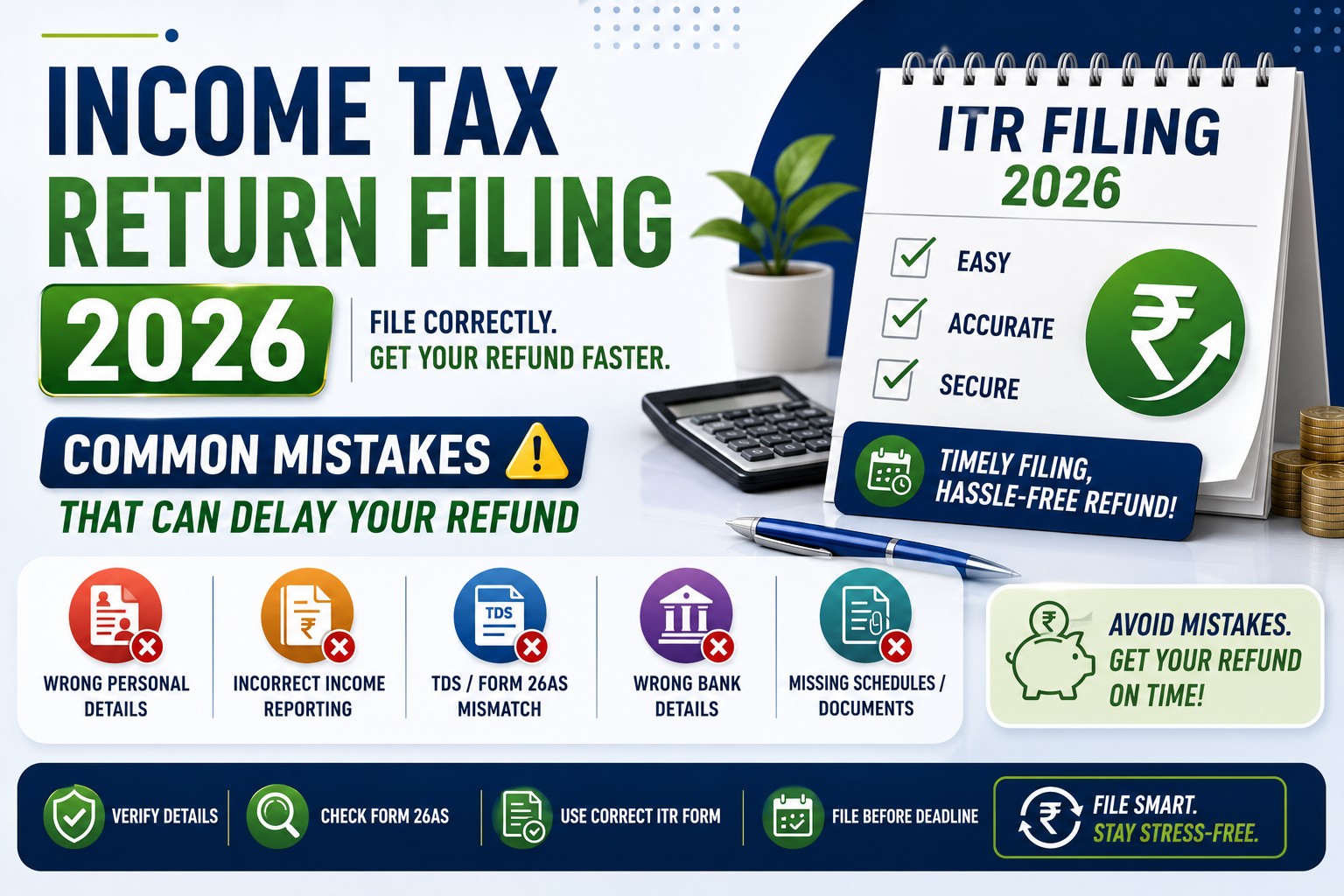
Refunds may be delayed due to:
- Incorrect personal information.
- Mismatch in reported income.
- Errors in TDS details.
- Invalid bank account information.
- Unverified Income Tax Return.
- Pending compliance requirements.
Fortunately, most of these issues are preventable with careful preparation.
1. Incorrect PAN or Aadhaar Details
Your PAN and Aadhaar serve as primary identity records for tax filing. Even a small mismatch in your name, date of birth, or PAN number can cause validation issues.
How to Avoid It
- Verify your PAN details before filing.
- Ensure Aadhaar is correctly linked where required.
- Match your name exactly with official records.
2. Incorrect Bank Account Details
Many taxpayers unintentionally enter an incorrect bank account number or IFSC code.
As a result:
- Refund cannot be credited.
- Refund processing is delayed.
- Additional verification may become necessary.
Before Filing, Check
- Account number.
- IFSC code.
- Account type.
- Pre-validation status.
- Bank account selected for refund credit.
Always double-check these details before submitting your return.
3. Not Matching Form 26AS
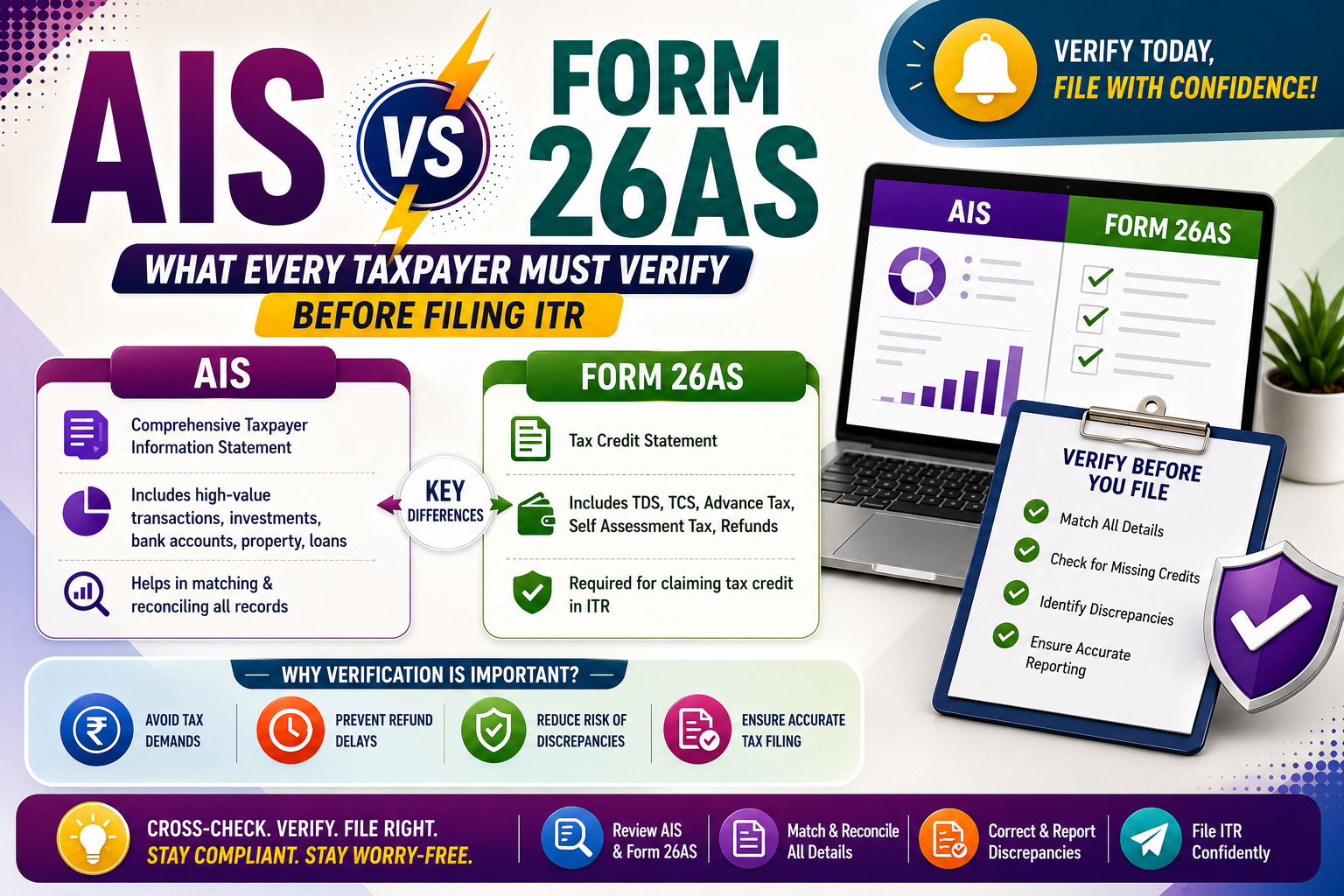
Form 26AS contains details of:
- TDS deducted by employers.
- Advance tax.
- Self-assessment tax.
- High-value financial transactions.
If the income or TDS reported in your ITR does not match Form 26AS, your return may require additional verification.
Best Practice
Compare every salary, TDS, and tax payment entry with Form 26AS before filing.
4. Ignoring the Annual Information Statement (AIS)
The Annual Information Statement (AIS) provides a comprehensive view of your financial transactions reported to the Income Tax Department.
AIS may include:
- Salary income.
- Interest from banks.
- Dividend income.
- Securities transactions.
- Mutual fund investments.
- Property transactions.
- Foreign remittances.
If you ignore AIS and omit reportable income, your return may be selected for further scrutiny or correction.
5. Choosing the Wrong ITR Form
Selecting an incorrect Income Tax Return form is one of the most common filing mistakes.
Examples include:
- Filing ITR-1 despite having capital gains.
- Reporting business income in the wrong form.
- Ignoring foreign assets or multiple house properties.
Using the appropriate ITR form helps avoid defective return notices and delays in processing.
6. Not Reporting All Sources of Income
Many taxpayers assume that only salary income needs to be disclosed while filing their Income Tax Return. However, all taxable income earned during the financial year must be reported.
Commonly overlooked income includes:
- Savings account interest
- Fixed Deposit (FD) interest
- Recurring Deposit (RD) interest
- Dividend income
- Rental income
- Family pension
- Freelancing or consulting income
- Income from side businesses
Even if tax has already been deducted at source, failing to disclose these income sources can create a mismatch with the records available to the Income Tax Department.
How to Avoid It
Before filing your return:
- Review your Annual Information Statement (AIS).
- Match details with Form 26AS.
- Check your bank statements.
- Verify interest certificates issued by banks.
- Include all reportable income in your ITR.
7. Selecting the Wrong Tax Regime
Since taxpayers can choose between the Old Tax Regime and the New Tax Regime (subject to applicable rules), selecting the wrong option may increase your tax liability or reduce your refund.
Many individuals simply accept the default regime without comparing both options.
Best Practice
Before filing:
- Compare tax calculations under both regimes.
- Evaluate deductions such as Section 80C, 80D, HRA, and home loan interest.
- Choose the regime that minimizes your overall tax liability.
A Chartered Accountant can help determine the most tax-efficient option based on your financial profile.
8. Forgetting to Report Capital Gains
If you have sold shares, mutual funds, property, or other capital assets during the financial year, the resulting capital gains or losses generally need to be reported.
Taxpayers often assume that transactions already reflected in brokerage statements do not require separate reporting, which is incorrect.
Common Examples
- Equity shares
- Mutual funds
- Real estate
- Gold ETFs
- Bonds
- Listed securities
Failure to report capital gains accurately can delay processing or lead to notices from the Income Tax Department.
9. Claiming Incorrect Deductions
Claiming deductions without proper eligibility or supporting documentation is another common reason for return discrepancies.
Examples include:
- Incorrect Section 80C claims
- Excess health insurance deductions
- Unsupported donation claims
- Incorrect home loan deductions
- Duplicate deduction claims
Always ensure that deductions claimed are supported by valid documents and are permissible under the applicable tax provisions.
10. Missing TDS Entries
Sometimes employers, banks, or other deductors may not have correctly reflected Tax Deducted at Source (TDS) details.
If you claim TDS that is not appearing in Form 26AS or AIS, your refund may be delayed until the discrepancy is resolved.
Recommendation
Cross-check:
- Form 16
- Form 26AS
- AIS
- Salary slips
- Bank TDS certificates
before submitting your return.
11. Filing Without E-Verification
Many taxpayers believe the filing process is complete once the return is submitted online.
However, an Income Tax Return is considered complete only after it has been successfully verified using one of the prescribed verification methods.
If verification is not completed within the permitted time, the return may be treated as invalid, resulting in delays in processing and refunds.
12. Waiting Until the Last Day
Last-minute filing is one of the biggest reasons taxpayers make avoidable mistakes.
Common issues include:
- Website traffic and slower portal response.
- Missing documents.
- Incorrect calculations.
- Inadequate time for review.
- Difficulty resolving technical issues before the deadline.
Filing early provides sufficient time to identify and correct any errors before submission.
13. Ignoring Income Tax Notices or Communications
Sometimes taxpayers receive emails or portal notifications requesting clarification, additional information, or correction of discrepancies.
Ignoring these communications can delay return processing and refund issuance.
Always:
- Check your registered email regularly.
- Monitor your e-Filing portal account.
- Respond to notices within the prescribed timeline.
14. Not Filing a Revised Return When Required
Mistakes happen—even after careful preparation.
If you discover errors after filing, such as omitted income, incorrect deductions, or inaccurate bank details, filing a Revised Return within the applicable time limit can help rectify the issue.
Prompt correction improves compliance and reduces the risk of future disputes.
15. Not Seeking Professional Advice for Complex Cases
While straightforward salary returns may be simple to file, taxpayers with complex financial situations often benefit from expert guidance.
Professional assistance is recommended if you have:
- Capital gains
- Multiple employers
- Foreign income or assets
- Business or professional income
- Rental income from multiple properties
- High-value investments
- Income tax notices
- NRI taxation concerns
An experienced Chartered Accountant can help ensure accurate reporting, legal tax optimisation, and faster processing.
How to Receive Your Income Tax Refund Faster
Following a systematic approach can significantly reduce the chances of refund delays.
Quick Checklist
✔ Verify PAN and Aadhaar details.
✔ Validate your bank account before filing.
✔ Match Form 16, Form 26AS, AIS, and TIS.
✔ Report all income sources accurately.
✔ Choose the correct ITR form.
✔ Compare both tax regimes before making your selection.
✔ Claim only eligible deductions.
✔ Complete e-verification immediately after filing.
✔ Respond promptly to any communication from the Income Tax Department.
✔ File well before the due date.
Expert Tips from Chartered Accountants
Experienced tax professionals recommend the following practices every filing season:
- Start collecting tax documents early.
- Reconcile all financial information before filing.
- Avoid estimating figures—use actual records.
- Retain supporting documents even after filing.
- Review every field carefully before submission.
- Don’t ignore even small discrepancies.
- Seek professional advice whenever your tax situation becomes more complex.
Conclusion
Receiving your Income Tax refund quickly is not just about filing your return—it is about filing it accurately.
Simple mistakes such as incorrect bank details, income mismatches, wrong ITR forms, unreported income, or delayed verification can unnecessarily prolong refund processing and create avoidable compliance issues.
By preparing your documents in advance, verifying all information carefully, and following the best practices outlined in this guide, you can significantly improve the accuracy of your return and reduce the chances of refund delays.
Need Professional Help with ITR Filing?
Whether you’re a salaried employee, freelancer, entrepreneur, investor, or NRI, Bharat A. Choudhary & Co. offers expert Income Tax Return filing services designed to ensure accuracy, compliance, and timely refund processing.
Contact our experienced Chartered Accountants today for reliable tax filing, personalized advice, and hassle-free compliance.
6. FAQ SECTION
1. Why is my Income Tax refund delayed even after filing my ITR?
Refunds may be delayed due to incorrect bank details, mismatched income, unverified returns, or discrepancies in Form 26AS or the Annual Information Statement (AIS).
2. Can incorrect bank details delay my tax refund?
If the bank account number, IFSC code, or account selected for refund is incorrect or not pre-validated, your refund may be delayed or fail to process. Always verify your bank details before submitting your return.
3. What happens if I choose the wrong ITR form?
A defective return may require correction or re-filing, delaying both processing and refund. Select the ITR form based on your income sources, not just your employment status.
4. Can I revise my Income Tax Return if I made a mistake?
If you discover an error after filing, such as omitted income or incorrect deductions, you can generally file a Revised Return within the prescribed timeline, subject to applicable rules.
5. How can I receive my Income Tax refund faster?
File your ITR accurately, complete e-verification promptly, and ensure all income and TDS details match official records.
6. Does e-verification affect refund processing?
Your Income Tax Return is processed only after successful verification. Delaying e-verification can postpone both return processing and refund issuance.
7. What documents should I check before filing my ITR?
Review PAN, Aadhaar, Form 16, Form 26AS, AIS, TIS, bank statements, investment proofs, and loan interest certificates (if applicable).
8. Should I hire a Chartered Accountant for ITR filing?
Professional assistance is recommended if your financial situation is complex.