
TL;DR
Before filing your Income Tax Return (ITR), it is essential to review both the Annual Information Statement (AIS) and Form 26AS. While Form 26AS primarily shows tax-related information such as TDS and tax payments, AIS provides a much broader view of your financial transactions. Verifying both documents helps prevent income mismatches, refund delays, defective returns, and Income Tax notices.
Why Verification Before Filing ITR Is So Important
Many taxpayers assume that Form 16 alone is sufficient for filing their Income Tax Return. However, the Income Tax Department now uses multiple information sources to verify the accuracy of your return.
If your ITR does not match the information available in AIS or Form 26AS, it may lead to:
- Delayed refund processing
- Additional verification
- Defective return notices
- Tax demand notices
- Increased scrutiny
Reviewing these records before filing significantly improves the accuracy of your return.
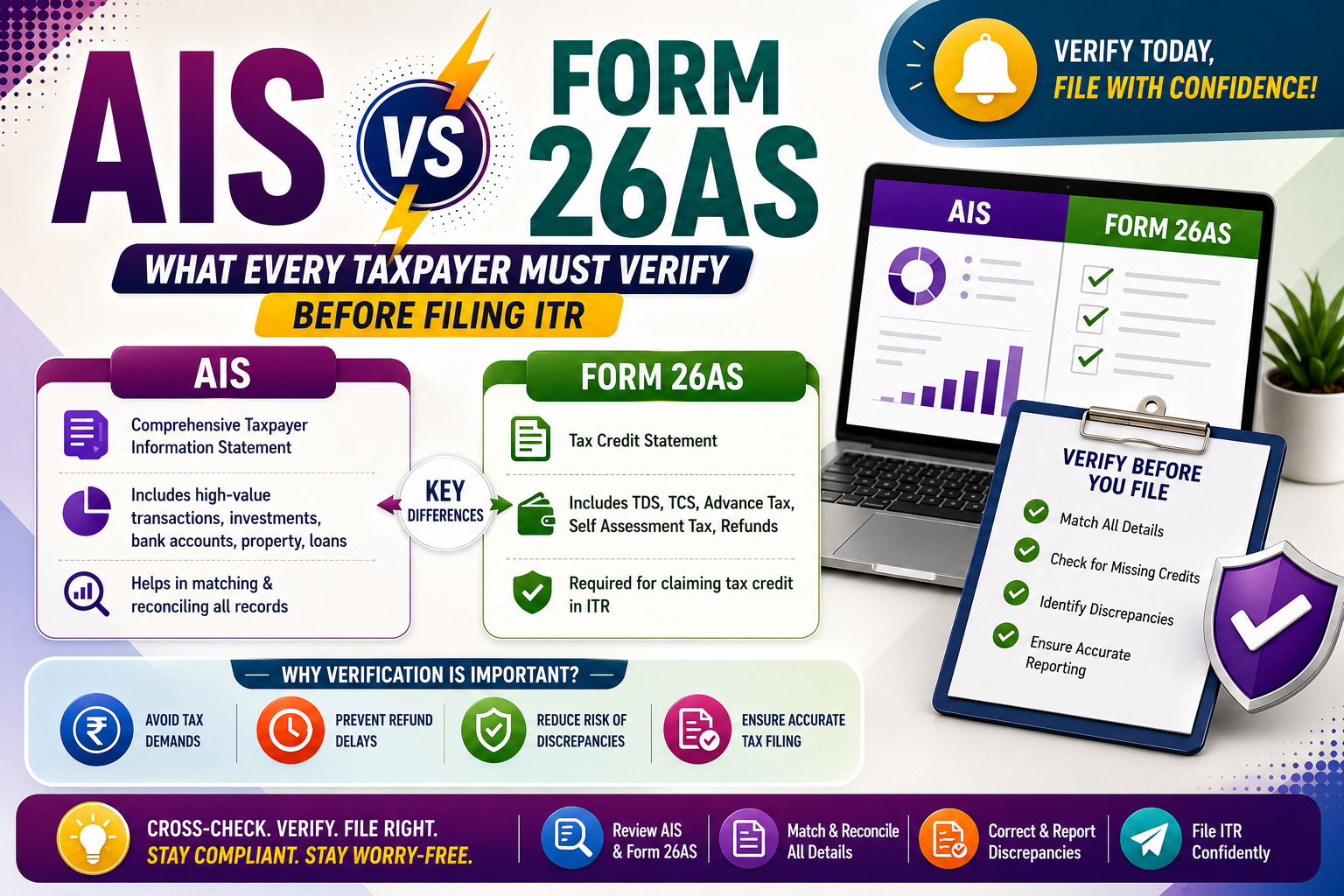
What is AIS (Annual Information Statement)?
The Annual Information Statement (AIS) is a comprehensive statement available on the Income Tax e-Filing portal that provides detailed information about your financial transactions reported to the Income Tax Department.
AIS includes a much wider range of information than Form 26AS.
Information Available in AIS
- Salary income
- Interest from savings accounts
- Fixed Deposit interest
- Dividend income
- Mutual fund transactions
- Equity share transactions
- Securities purchases and sales
- Property transactions
- Foreign remittances
- GST-related information (where applicable)
- Tax Deducted at Source (TDS)
- Tax Collected at Source (TCS)
- Advance tax payments
- Self-assessment tax
AIS is designed to help taxpayers report all relevant income accurately while reducing the chances of under-reporting.
What is Form 26AS?
Form 26AS is a consolidated tax credit statement that primarily reflects taxes deposited against your Permanent Account Number (PAN).
It is commonly used to verify whether taxes deducted or paid on your behalf have been correctly credited.
Information Available in Form 26AS
- Tax Deducted at Source (TDS)
- Tax Collected at Source (TCS)
- Advance tax payments
- Self-assessment tax
- Refund details
- High-value transactions (limited)
- Details of taxes deposited with the Income Tax Department
Although Form 26AS remains an important document, it does not provide the same breadth of financial information as AIS.
AIS vs Form 26AS: Key Differences
| Feature | AIS | Form 26AS |
|---|---|---|
| Purpose | Comprehensive financial information | Tax credit statement |
| Salary Information | ✔ | Limited |
| Interest Income | ✔ | Partial |
| Dividend Income | ✔ | Limited |
| Mutual Fund Transactions | ✔ | No |
| Share Transactions | ✔ | No |
| Property Transactions | ✔ | Limited |
| TDS Details | ✔ | ✔ |
| TCS Details | ✔ | ✔ |
| Advance Tax | ✔ | ✔ |
| Self-Assessment Tax | ✔ | ✔ |
| Refund Details | Partial | ✔ |
Why Should You Check Both Documents?
Many taxpayers only review Form 26AS before filing their ITR. However, relying on Form 26AS alone can result in missed income reporting because it does not capture all financial transactions reflected in AIS.
Using both documents together allows you to:
- Verify tax credits accurately.
- Identify unreported income.
- Match TDS entries.
- Detect reporting errors.
- Minimize the risk of tax notices.
- Improve refund processing efficiency.
What Every Taxpayer Must Verify Before Filing ITR
Reviewing your AIS and Form 26AS before filing your Income Tax Return can help you identify discrepancies early and avoid unnecessary delays or notices. Here’s a checklist of the key items every taxpayer should verify.
1. Salary Income
Compare the salary reported in your:
- Form 16
- Annual Information Statement (AIS)
- Income Tax Return
Ensure that the salary income reported in your ITR matches the records available with the Income Tax Department.
If you changed jobs during the financial year, remember to include income from all employers.
2. Tax Deducted at Source (TDS)
Check whether all TDS entries deducted by:
- Employer
- Banks
- Financial institutions
- Clients (for professionals)
- Tenants (where applicable)
are correctly reflected in Form 26AS and AIS.
Missing TDS entries may reduce your refund or increase your tax liability.
3. Interest Income
Interest income is one of the most frequently missed items while filing an ITR.
Verify interest earned from:
- Savings accounts
- Fixed Deposits (FDs)
- Recurring Deposits (RDs)
- Post Office deposits
- Corporate deposits
AIS generally reports these amounts based on information submitted by financial institutions.
4. Dividend Income
Many taxpayers forget to report dividends received from:
- Equity shares
- Mutual funds
- REITs
- InvITs
Cross-check dividend income appearing in AIS and include it in your return wherever applicable.
5. Capital Gains
If you have sold:
- Shares
- Mutual funds
- Property
- Gold ETFs
- Bonds
- Other capital assets
verify that the related transactions appearing in AIS are accurately reported in your ITR.
Remember that AIS reflects transaction information—it does not calculate your taxable capital gains. You are responsible for determining the correct gain or loss based on applicable tax rules.
6. Bank Account Details
Before submitting your return:
✔ Verify account number.
✔ Check IFSC code.
✔ Ensure the account is pre-validated.
✔ Select the correct account for refund credit.
Incorrect banking information is one of the leading causes of refund delays.
7. Personal Information
Confirm that your:
- PAN
- Aadhaar
- Name
- Date of Birth
- Mobile Number
- Email Address
- Residential Address
match the details available on the Income Tax e-Filing portal.
Even small discrepancies can result in processing issues.
Common AIS and Form 26AS Mismatches
It is not uncommon for taxpayers to notice differences between AIS, Form 26AS, and their own financial records. Understanding these mismatches can help you take corrective action before filing.
Mismatch 1: Missing TDS
Your employer or bank may have deducted TDS, but it has not yet been reported or updated.
What to Do:
Contact the deductor and request correction if necessary.
Mismatch 2: Additional Interest Income
AIS may show interest from a bank account that you overlooked.
What to Do:
Verify the amount with your bank statements and include the taxable income in your ITR if applicable.
Mismatch 3: Securities Transactions
AIS may contain details of share or mutual fund transactions, while Form 26AS may not.
What to Do:
Use your broker’s capital gains statement to calculate the correct taxable gain or loss before filing.
Mismatch 4: Duplicate Entries
Occasionally, a transaction may appear more than once due to reporting issues.
What to Do:
Cross-check with supporting documents before reporting the income. If required, provide feedback through the AIS portal as permitted.
Mismatch 5: Incorrect Financial Information
In some cases, AIS may contain incorrect or outdated information reported by third parties.
What to Do:
Review the relevant documents and use the feedback mechanism available on the Income Tax portal where applicable. Maintain supporting records for future reference.
How to Handle Errors Before Filing
If you identify discrepancies between your records, AIS, and Form 26AS:
Step 1
Download the latest AIS and Form 26AS immediately before filing.
Step 2
Compare them with:
- Form 16
- Salary slips
- Bank statements
- Interest certificates
- Investment statements
- Capital gains reports
Step 3
Identify missing or incorrect entries.
Step 4
If required:
- Contact your employer.
- Contact your bank.
- Contact your broker.
- Request correction from the deductor.
- Submit feedback through the AIS portal where appropriate.
Step 5
File your ITR only after reconciling all major differences or ensuring that the information reported in your return is accurate and supported by documentation.
Expert Tips from Chartered Accountants
Tax professionals recommend the following best practices before filing your Income Tax Return:
- Download the latest AIS and Form 26AS rather than relying on older copies.
- Do not rely solely on Form 16.
- Review all sources of income, including interest and investments.
- Keep supporting documents readily available.
- Reconcile all financial records before submission.
- File your return well before the due date to allow time for corrections if needed.
- Seek professional guidance if you have multiple income sources, capital gains, foreign assets, or complex tax matters.
Conclusion
AIS and Form 26AS are complementary documents that play a crucial role in accurate Income Tax Return filing.
While Form 26AS primarily confirms your tax credits, AIS provides a broader view of your financial transactions. Reviewing both before filing helps ensure that your income is reported correctly, your tax credits are claimed accurately, and your return is processed without unnecessary delays.
Taking a little extra time to verify these documents can reduce the risk of notices, refund delays, and future compliance issues.
Need Help Filing Your ITR?
If you’re unsure how to reconcile AIS, Form 26AS, or other tax documents, the experts at Bharat A. Choudhary & Co. can help.
Our experienced Chartered Accountants provide end-to-end assistance with:
- Income Tax Return Filing
- Tax Planning
- Capital Gains Reporting
- Tax Regime Comparison
- Revised Returns
- Income Tax Notices
- NRI Taxation
- Tax Compliance Services
Book a consultation today to ensure your ITR is accurate, compliant, and filed with confidence.
6. FAQ SECTION
1. What is the difference between AIS and Form 26AS?
AIS provides a comprehensive summary of your financial transactions, while Form 26AS primarily shows your tax credits, such as TDS, TCS, advance tax, and self-assessment tax.
2. Is AIS more important than Form 26AS?
AIS provides detailed financial transaction information, whereas Form 26AS confirms tax credits and payments. Taxpayers should review both documents before filing their Income Tax Return to ensure complete and accurate reporting.
3. Can I file my ITR using only Form 26AS?
Form 26AS alone may not include all your income details. Since AIS contains additional information such as interest income, dividends, securities transactions, and other reportable financial activities, relying solely on Form 26AS could result in incomplete reporting.
4. What should I do if AIS and Form 26AS show different information?
Review Form 16, bank statements, investment reports, and other supporting documents. If you identify incorrect information in AIS, you may use the feedback facility available on the Income Tax e-Filing portal, where applicable.
5. Can AIS mismatch delay my Income Tax refund?
If your ITR does not align with the information available in AIS or Form 26AS, the Income Tax Department may require additional verification, which can delay processing and refund issuance.
6. How often should I check AIS before filing my ITR?
Financial information in AIS may be updated periodically by reporting entities. Reviewing the latest version before filing helps ensure your return reflects the most current information.
7. What documents should I compare with AIS and Form 26AS?
Compare them with Form 16, salary slips, bank statements, interest certificates, investment statements, capital gains reports, and tax payment challans.
8. Should I consult a Chartered Accountant if I find discrepancies?
Yes, especially if the differences involve multiple income sources, capital gains, business income, or foreign assets.