
Income Tax Notice in 2026? Common Reasons and How to Respond
TL;DR Receiving an Income Tax notice does not necessarily mean you have done something wrong. In many cases, notices are issued to seek clarification, request additional information, or correct discrepancies in your Income Tax Return (ITR). Understanding the reason for the notice and responding within the prescribed timeline can help resolve the matter smoothly. What Is an Income Tax Notice? An Income Tax notice is an official communication issued by the Income Tax Department to a taxpayer. The notice may request: Additional information. Clarification regarding reported income. Verification of deductions. Confirmation of tax payments. Correction of discrepancies. Submission of supporting documents. Some notices are routine and informational, while others may relate to assessments or compliance issues. The key is to read the notice carefully and understand what action, if any, is required. Should You Panic After Receiving an Income Tax Notice? Absolutely not. Many taxpayers become anxious as soon as they receive a notice from the Income Tax Department. However, most notices are issued for verification or clarification purposes and can often be resolved by providing accurate information within the specified time. Ignoring a notice, however, may lead to additional proceedings, penalties, or delays in processing your return. Common Reasons You May Receive an Income Tax Notice 1. Income Mismatch One of the most common reasons for receiving a notice is a mismatch between the income reported in your ITR and the information available with the Income Tax Department. Examples include: Salary mismatch Interest income not reported Dividend income omitted Rental income excluded Freelancing income not disclosed Reconciling your income with Form 16, AIS, and Form 26AS before filing helps reduce the risk of such notices. 2. Incorrect Deduction Claims Claiming deductions that are unsupported or incorrectly calculated may attract verification. Examples include: Section 80C Health insurance deductions Home loan deductions Donations Education loan interest Always retain supporting documents for every deduction claimed. 3. High-Value Financial Transactions Banks and financial institutions report certain specified transactions to the Income Tax Department. Examples may include: Large cash deposits Significant property purchases or sales High-value investments Large credit card payments Securities transactions If these transactions do not align with the income reported in your return, the Department may seek clarification. 4. TDS or Tax Credit Mismatch A mismatch between your claimed tax credits and the records available in Form 26AS may trigger a notice. Before filing, always compare: Form 16 Form 26AS AIS TDS certificates to ensure consistency. 5. Non-Filing of Income Tax Return If you were required to file an Income Tax Return but failed to do so despite having taxable income or reportable financial transactions, you may receive a notice requesting compliance. Timely filing helps avoid unnecessary notices and penalties. 6. Incorrect ITR Form Using the wrong Income Tax Return (ITR) form is a common mistake that may lead to a defective return notice or a request for clarification. For example: Filing ITR-1 despite having capital gains. Reporting business income using an incorrect ITR form. Not disclosing foreign assets or foreign income where required. Always select the ITR form based on your income sources and taxpayer category. 7. Failure to Report Capital Gains If you have sold: Shares Mutual funds Property Gold Bonds during the financial year, you may need to report the resulting capital gains or losses in your Income Tax Return. Failure to disclose these transactions, especially when they are reflected in the Annual Information Statement (AIS), may trigger a notice seeking clarification. 8. Errors in Personal Information Simple mistakes in personal details can also lead to processing issues. Verify the following before filing: PAN Aadhaar Name Date of Birth Mobile Number Email Address Bank Account Details Incorrect information may delay communication or refund processing. Types of Income Tax Notices Not every notice has the same purpose. Understanding the nature of the notice helps you respond appropriately. Intimation Notice This notice is generally issued after the Income Tax Department processes your return. It may confirm that your return has been accepted or highlight differences between your filed return and the Department’s records. Defective Return Notice A defective return notice may be issued if your ITR contains missing information, incorrect details, or has been filed using the wrong ITR form. Responding within the prescribed time helps prevent the return from being treated as invalid. Scrutiny Notice A scrutiny notice is issued when the Department requires additional information or supporting documents to verify specific aspects of your return. Receiving a scrutiny notice does not automatically imply tax evasion or wrongdoing. It simply means the Department requires further clarification. Demand Notice If the Department determines that additional tax is payable after processing your return, a demand notice may be issued specifying the outstanding amount and the reason. Review the notice carefully and verify the calculations before responding. Reassessment Notice A reassessment notice may be issued if the Department believes that certain income has not been assessed correctly, subject to the applicable provisions of the Income-tax Act. Professional assistance is often advisable in such cases. How to Respond to an Income Tax Notice Receiving a notice is not the end of the process. A timely and accurate response is often sufficient to resolve the matter. Step 1: Read the Notice Carefully Understand: The reason for the notice. The relevant assessment year. The information or documents requested. The response deadline. Avoid making assumptions before reviewing the details. Step 2: Verify the Information Compare the notice with: Your filed Income Tax Return. Form 16. Form 26AS. Annual Information Statement (AIS). Tax payment challans. Bank statements. Investment records. Identify any discrepancies before responding. Step 3: Gather Supporting Documents Depending on the issue, you may need documents such as: Salary certificates. Interest certificates. Capital gains statements. Investment proofs. Home loan interest certificates. Rent receipts. Tax payment receipts. Organizing these documents in advance helps ensure a complete response. Step 4: Respond Within the Deadline Most notices specify a timeline for submitting your response. Missing the deadline may result in additional proceedings, penalties, or ex parte action. Always
AIS vs Form 26AS: What Every Taxpayer Must Verify Before Filing ITR
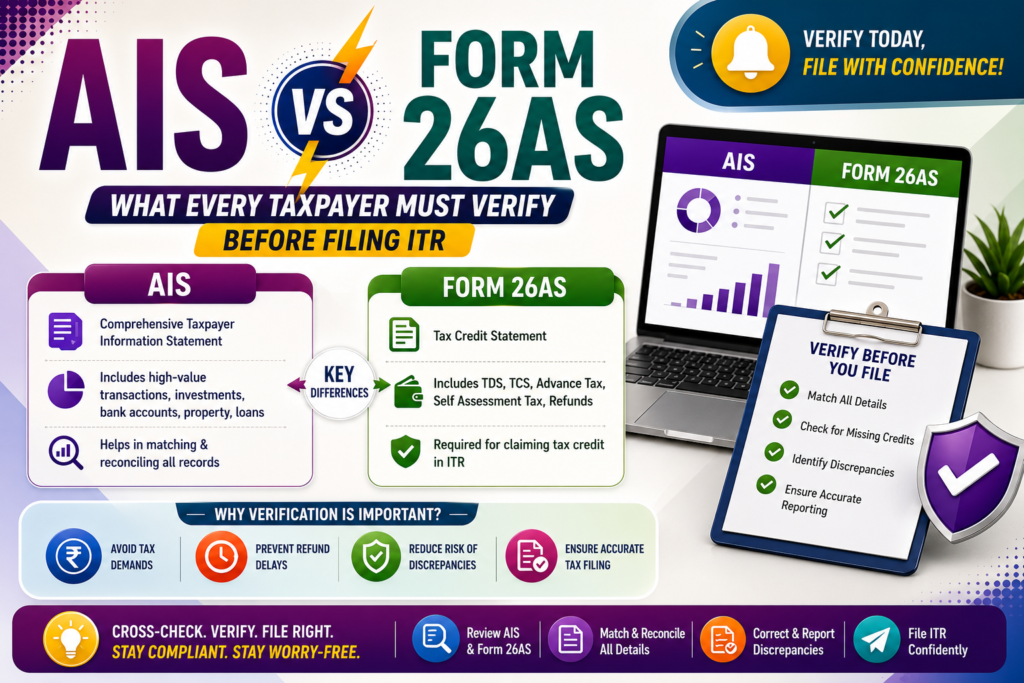
TL;DR Before filing your Income Tax Return (ITR), it is essential to review both the Annual Information Statement (AIS) and Form 26AS. While Form 26AS primarily shows tax-related information such as TDS and tax payments, AIS provides a much broader view of your financial transactions. Verifying both documents helps prevent income mismatches, refund delays, defective returns, and Income Tax notices. Why Verification Before Filing ITR Is So Important Many taxpayers assume that Form 16 alone is sufficient for filing their Income Tax Return. However, the Income Tax Department now uses multiple information sources to verify the accuracy of your return. If your ITR does not match the information available in AIS or Form 26AS, it may lead to: Delayed refund processing Additional verification Defective return notices Tax demand notices Increased scrutiny Reviewing these records before filing significantly improves the accuracy of your return. What is AIS (Annual Information Statement)? The Annual Information Statement (AIS) is a comprehensive statement available on the Income Tax e-Filing portal that provides detailed information about your financial transactions reported to the Income Tax Department. AIS includes a much wider range of information than Form 26AS. Information Available in AIS Salary income Interest from savings accounts Fixed Deposit interest Dividend income Mutual fund transactions Equity share transactions Securities purchases and sales Property transactions Foreign remittances GST-related information (where applicable) Tax Deducted at Source (TDS) Tax Collected at Source (TCS) Advance tax payments Self-assessment tax AIS is designed to help taxpayers report all relevant income accurately while reducing the chances of under-reporting. What is Form 26AS? Form 26AS is a consolidated tax credit statement that primarily reflects taxes deposited against your Permanent Account Number (PAN). It is commonly used to verify whether taxes deducted or paid on your behalf have been correctly credited. Information Available in Form 26AS Tax Deducted at Source (TDS) Tax Collected at Source (TCS) Advance tax payments Self-assessment tax Refund details High-value transactions (limited) Details of taxes deposited with the Income Tax Department Although Form 26AS remains an important document, it does not provide the same breadth of financial information as AIS. AIS vs Form 26AS: Key Differences Feature AIS Form 26AS Purpose Comprehensive financial information Tax credit statement Salary Information ✔ Limited Interest Income ✔ Partial Dividend Income ✔ Limited Mutual Fund Transactions ✔ No Share Transactions ✔ No Property Transactions ✔ Limited TDS Details ✔ ✔ TCS Details ✔ ✔ Advance Tax ✔ ✔ Self-Assessment Tax ✔ ✔ Refund Details Partial ✔ Why Should You Check Both Documents? Many taxpayers only review Form 26AS before filing their ITR. However, relying on Form 26AS alone can result in missed income reporting because it does not capture all financial transactions reflected in AIS. Using both documents together allows you to: Verify tax credits accurately. Identify unreported income. Match TDS entries. Detect reporting errors. Minimize the risk of tax notices. Improve refund processing efficiency. What Every Taxpayer Must Verify Before Filing ITR Reviewing your AIS and Form 26AS before filing your Income Tax Return can help you identify discrepancies early and avoid unnecessary delays or notices. Here’s a checklist of the key items every taxpayer should verify. 1. Salary Income Compare the salary reported in your: Form 16 Annual Information Statement (AIS) Income Tax Return Ensure that the salary income reported in your ITR matches the records available with the Income Tax Department. If you changed jobs during the financial year, remember to include income from all employers. 2. Tax Deducted at Source (TDS) Check whether all TDS entries deducted by: Employer Banks Financial institutions Clients (for professionals) Tenants (where applicable) are correctly reflected in Form 26AS and AIS. Missing TDS entries may reduce your refund or increase your tax liability. 3. Interest Income Interest income is one of the most frequently missed items while filing an ITR. Verify interest earned from: Savings accounts Fixed Deposits (FDs) Recurring Deposits (RDs) Post Office deposits Corporate deposits AIS generally reports these amounts based on information submitted by financial institutions. 4. Dividend Income Many taxpayers forget to report dividends received from: Equity shares Mutual funds REITs InvITs Cross-check dividend income appearing in AIS and include it in your return wherever applicable. 5. Capital Gains If you have sold: Shares Mutual funds Property Gold ETFs Bonds Other capital assets verify that the related transactions appearing in AIS are accurately reported in your ITR. Remember that AIS reflects transaction information—it does not calculate your taxable capital gains. You are responsible for determining the correct gain or loss based on applicable tax rules. 6. Bank Account Details Before submitting your return: ✔ Verify account number. ✔ Check IFSC code. ✔ Ensure the account is pre-validated. ✔ Select the correct account for refund credit. Incorrect banking information is one of the leading causes of refund delays. 7. Personal Information Confirm that your: PAN Aadhaar Name Date of Birth Mobile Number Email Address Residential Address match the details available on the Income Tax e-Filing portal. Even small discrepancies can result in processing issues. Common AIS and Form 26AS Mismatches It is not uncommon for taxpayers to notice differences between AIS, Form 26AS, and their own financial records. Understanding these mismatches can help you take corrective action before filing. Mismatch 1: Missing TDS Your employer or bank may have deducted TDS, but it has not yet been reported or updated. What to Do: Contact the deductor and request correction if necessary. Mismatch 2: Additional Interest Income AIS may show interest from a bank account that you overlooked. What to Do: Verify the amount with your bank statements and include the taxable income in your ITR if applicable. Mismatch 3: Securities Transactions AIS may contain details of share or mutual fund transactions, while Form 26AS may not. What to Do: Use your broker’s capital gains statement to calculate the correct taxable gain or loss before filing. Mismatch 4: Duplicate Entries Occasionally, a transaction may appear more than once due to reporting issues. What to Do: Cross-check with supporting documents before reporting the income.
Income Tax Return Filing 2026: Common Mistakes That Can Delay Your Refund
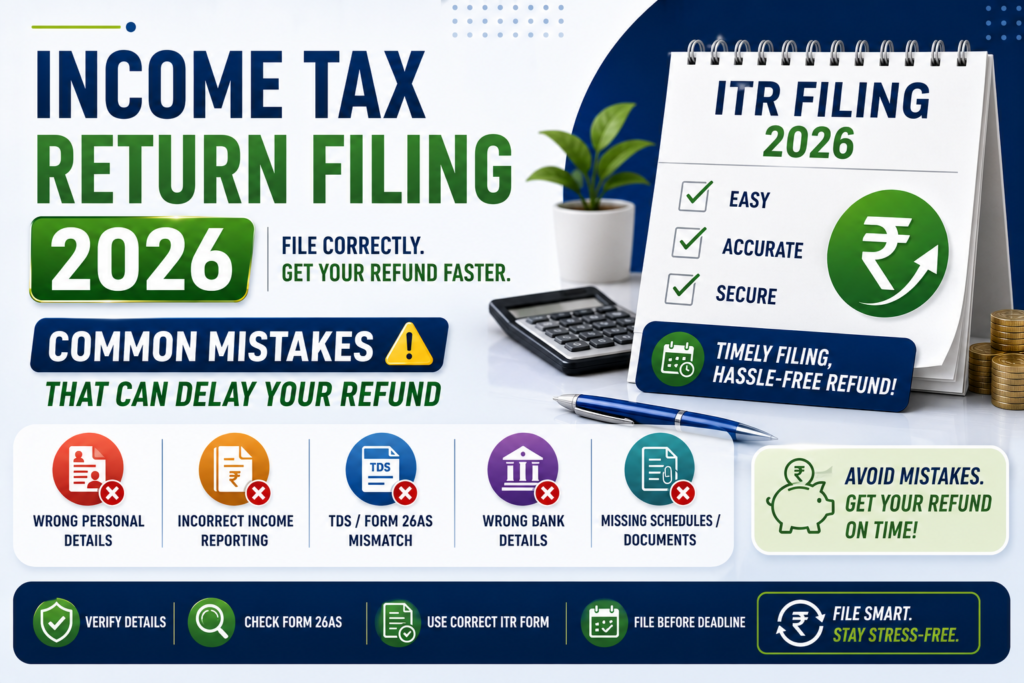
TL;DR Many taxpayers expect their Income Tax refund to be credited soon after filing their return. However, simple mistakes such as incorrect bank details, mismatched income, selecting the wrong ITR form, or failing to verify the return can significantly delay refund processing. This guide highlights the most common errors and explains how to avoid them for a faster, hassle-free refund. Why Do Income Tax Refunds Get Delayed? One of the most common misconceptions is that filing an Income Tax Return automatically guarantees a quick refund. In reality, the Income Tax Department processes refunds only after verifying the accuracy and completeness of the return. Refunds may be delayed due to: Incorrect personal information. Mismatch in reported income. Errors in TDS details. Invalid bank account information. Unverified Income Tax Return. Pending compliance requirements. Fortunately, most of these issues are preventable with careful preparation. 1. Incorrect PAN or Aadhaar Details Your PAN and Aadhaar serve as primary identity records for tax filing. Even a small mismatch in your name, date of birth, or PAN number can cause validation issues. How to Avoid It Verify your PAN details before filing. Ensure Aadhaar is correctly linked where required. Match your name exactly with official records. 2. Incorrect Bank Account Details Many taxpayers unintentionally enter an incorrect bank account number or IFSC code. As a result: Refund cannot be credited. Refund processing is delayed. Additional verification may become necessary. Before Filing, Check Account number. IFSC code. Account type. Pre-validation status. Bank account selected for refund credit. Always double-check these details before submitting your return. 3. Not Matching Form 26AS Form 26AS contains details of: TDS deducted by employers. Advance tax. Self-assessment tax. High-value financial transactions. If the income or TDS reported in your ITR does not match Form 26AS, your return may require additional verification. Best Practice Compare every salary, TDS, and tax payment entry with Form 26AS before filing. 4. Ignoring the Annual Information Statement (AIS) The Annual Information Statement (AIS) provides a comprehensive view of your financial transactions reported to the Income Tax Department. AIS may include: Salary income. Interest from banks. Dividend income. Securities transactions. Mutual fund investments. Property transactions. Foreign remittances. If you ignore AIS and omit reportable income, your return may be selected for further scrutiny or correction. 5. Choosing the Wrong ITR Form Selecting an incorrect Income Tax Return form is one of the most common filing mistakes. Examples include: Filing ITR-1 despite having capital gains. Reporting business income in the wrong form. Ignoring foreign assets or multiple house properties. Using the appropriate ITR form helps avoid defective return notices and delays in processing. 6. Not Reporting All Sources of Income Many taxpayers assume that only salary income needs to be disclosed while filing their Income Tax Return. However, all taxable income earned during the financial year must be reported. Commonly overlooked income includes: Savings account interest Fixed Deposit (FD) interest Recurring Deposit (RD) interest Dividend income Rental income Family pension Freelancing or consulting income Income from side businesses Even if tax has already been deducted at source, failing to disclose these income sources can create a mismatch with the records available to the Income Tax Department. How to Avoid It Before filing your return: Review your Annual Information Statement (AIS). Match details with Form 26AS. Check your bank statements. Verify interest certificates issued by banks. Include all reportable income in your ITR. 7. Selecting the Wrong Tax Regime Since taxpayers can choose between the Old Tax Regime and the New Tax Regime (subject to applicable rules), selecting the wrong option may increase your tax liability or reduce your refund. Many individuals simply accept the default regime without comparing both options. Best Practice Before filing: Compare tax calculations under both regimes. Evaluate deductions such as Section 80C, 80D, HRA, and home loan interest. Choose the regime that minimizes your overall tax liability. A Chartered Accountant can help determine the most tax-efficient option based on your financial profile. 8. Forgetting to Report Capital Gains If you have sold shares, mutual funds, property, or other capital assets during the financial year, the resulting capital gains or losses generally need to be reported. Taxpayers often assume that transactions already reflected in brokerage statements do not require separate reporting, which is incorrect. Common Examples Equity shares Mutual funds Real estate Gold ETFs Bonds Listed securities Failure to report capital gains accurately can delay processing or lead to notices from the Income Tax Department. 9. Claiming Incorrect Deductions Claiming deductions without proper eligibility or supporting documentation is another common reason for return discrepancies. Examples include: Incorrect Section 80C claims Excess health insurance deductions Unsupported donation claims Incorrect home loan deductions Duplicate deduction claims Always ensure that deductions claimed are supported by valid documents and are permissible under the applicable tax provisions. 10. Missing TDS Entries Sometimes employers, banks, or other deductors may not have correctly reflected Tax Deducted at Source (TDS) details. If you claim TDS that is not appearing in Form 26AS or AIS, your refund may be delayed until the discrepancy is resolved. Recommendation Cross-check: Form 16 Form 26AS AIS Salary slips Bank TDS certificates before submitting your return. 11. Filing Without E-Verification Many taxpayers believe the filing process is complete once the return is submitted online. However, an Income Tax Return is considered complete only after it has been successfully verified using one of the prescribed verification methods. If verification is not completed within the permitted time, the return may be treated as invalid, resulting in delays in processing and refunds. 12. Waiting Until the Last Day Last-minute filing is one of the biggest reasons taxpayers make avoidable mistakes. Common issues include: Website traffic and slower portal response. Missing documents. Incorrect calculations. Inadequate time for review. Difficulty resolving technical issues before the deadline. Filing early provides sufficient time to identify and correct any errors before submission. 13. Ignoring Income Tax Notices or Communications Sometimes taxpayers receive emails or portal notifications requesting clarification, additional information, or correction of discrepancies. Ignoring these communications
New Income Tax Regime vs Old Regime (AY 2026-27): Which One Saves More Tax?
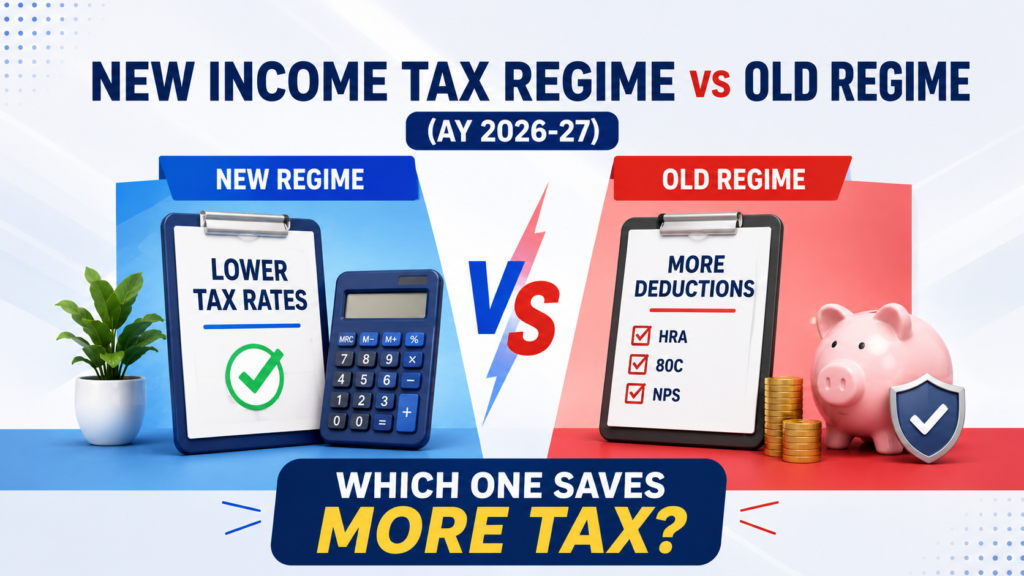
TL;DR For AY 2026–27, the New Tax Regime is simpler with lower slab rates, but limited deductions. The Old Tax Regime offers higher deductions like 80C, HRA, and home loan interest. If your deductions are high, Old Regime saves more tax. If not, New Regime is usually better. New Income Tax Regime vs Old Tax Regime (AY 2026-27) Choosing between the Old and New Tax Regime is one of the most important financial decisions for salaried individuals in India. The right choice can directly impact your annual savings, refund amount, and overall tax liability. With continuous changes in income tax rules, especially after recent budget updates, taxpayers are often confused about which regime actually saves more money. Let’s break it down in a simple, practical way. Understanding Both Tax Regimes Old Tax Regime The Old Tax Regime allows taxpayers to reduce taxable income using exemptions and deductions such as: Section 80C (EPF, PPF, ELSS, LIC) HRA exemption Home loan interest deduction 80D health insurance LTA benefits Standard deduction (for salaried individuals) This regime encourages tax planning through investments and savings. New Tax Regime The New Tax Regime offers: Lower slab rates Higher rebate benefits Simplified filing process Fewer exemptions and deductions allowed It is designed for simplicity, not investment-based tax saving. Key Differences Between Old and New Tax Regime Feature Old Regime New Regime Tax Slabs Higher Lower Deductions Allowed Mostly not allowed HRA Allowed Not allowed 80C Benefits Allowed Not allowed Complexity High Low Best For Investors & planners Simple salary earners Deductions: What You Lose or Gain Old Tax Regime Benefits You can reduce taxable income through: ₹1.5 lakh under Section 80C ₹25,000–₹50,000 under 80D HRA exemption (based on rent) Home loan interest deduction Standard deduction New Tax Regime Benefits Lower tax slabs Higher rebate for eligible income levels Easier compliance No need for investment proofs Real Salary Comparison Example Example: ₹10,00,000 annual salary Old Tax Regime (with deductions) Assume deductions: ₹2,00,000 Taxable income reduces → Lower tax liability New Tax Regime No deductions applied → Tax calculated on full salary but at lower rates 👉 Result: If deductions are high → Old Regime saves more If deductions are low → New Regime saves more Which Tax Regime Should You Choose? Choose Old Tax Regime if: You invest under 80C regularly You pay home loan interest You claim HRA You have insurance policies You actively do tax planning Choose New Tax Regime if: You have minimal investments You want simple tax filing You don’t claim many deductions You prefer higher in-hand salary Common Mistakes Taxpayers Make Automatically selecting new regime without comparison Ignoring deductions eligibility Not considering HRA benefits Not calculating both scenarios Missing professional guidance Expert CA Insight Most salaried individuals in India fall into a “break-even zone” where both regimes are close. A Chartered Accountant can help by: Running both tax simulations Identifying hidden deductions Planning salary restructuring Maximizing legal tax savings Conclusion There is no single “best” tax regime for everyone. The right choice depends entirely on your income structure, deductions, and financial planning habits. Before filing your ITR for AY 2026–27, always compare both regimes carefully. 6. FAQ SECTION 1. Which tax regime is better for AY 2026-27? It depends on your deductions. Old regime is better for high deductions, new regime for simpler cases. 2. Can I switch between old and new tax regime every year? Yes, salaried individuals can choose between regimes every financial year. 3. Is standard deduction available in the new tax regime? The new tax regime now allows a standard deduction for salaried individuals, making it more attractive compared to earlier years, though most other exemptions are still not allowed. 4. Who should choose the old tax regime? If you invest in 80C instruments, pay home loan interest, or claim HRA, the old regime may help reduce taxable income significantly. 5. Who should choose the new tax regime? Individuals with fewer deductions and simple salary structures should choose the new regime. 6. Which regime gives higher tax savings? Savings depend on your income level, deductions, and financial planning. A personalized calculation is necessary to determine the best option. 7. Can I change my tax regime after filing ITR? You may revise your return under certain conditions, but it is always better to choose the correct regime initially to avoid complications. 8. Do I need a CA to choose the right tax regime? A CA can compare both regimes using your actual salary structure and deductions to ensure maximum tax savings. BLOG BY: BHARAT A. CHOUDHARY & Co.
ITR Filing Due Date 2026: Last Date, Penalties & Late Filing Rules

TL;DR Missing your Income Tax Return (ITR) filing deadline can lead to late filing fees, interest on unpaid taxes, delayed refunds, and the loss of certain tax benefits. For most salaried individuals, the due date for filing ITR for Assessment Year (AY) 2026–27 is 31 July 2026. Understanding the applicable deadlines, penalties, and available options such as belated or revised returns can help you stay compliant and avoid unnecessary costs. Why Filing Your ITR on Time Matters Many taxpayers assume that if their employer has already deducted TDS, they do not need to worry about filing an Income Tax Return. However, filing your ITR is important even if your tax liability has already been discharged through TDS. Timely filing offers several advantages: Claim income tax refunds faster. Avoid late filing fees and interest. Carry forward eligible capital and business losses. Maintain a strong financial record for loans and visas. Reduce the likelihood of receiving notices for non-compliance. Stay compliant with the Income-tax Act. Filing your return early also gives you sufficient time to correct any errors before statutory deadlines expire. ITR Filing Due Dates for AY 2026–27 The Income Tax Department prescribes different due dates depending on the category of taxpayer. Taxpayer Category Due Date* Salaried Individuals (ITR-1 / ITR-2, non-audit) 31 July 2026 Non-audit Business/Professional Cases 31 August 2026 Taxpayers Requiring Audit 31 October 2026 Belated Return 31 December 2026 Revised Return 31 March 2027 Subject to any extension notified by the Income Tax Department. It is always advisable to file well before the due date instead of waiting until the final week, when portal traffic is typically at its highest. What Happens If You Miss the ITR Filing Due Date? Missing the filing deadline does not necessarily mean you cannot file your return, but it can result in several financial and compliance consequences. Some of the common implications include: Late filing fee under the Income-tax Act. Interest on outstanding tax liability. Delay in receiving tax refunds. Loss of the ability to carry forward certain losses. Increased scrutiny in specific cases. Additional compliance if a revised or updated return becomes necessary. Even if no tax is payable, filing late may still affect your financial documentation and eligibility for certain tax benefits. Late Filing Fee Under Section 234F If you file your Income Tax Return after the prescribed due date, you may be liable to pay a late filing fee under Section 234F of the Income-tax Act. Total Income Maximum Late Filing Fee Up to ₹5 lakh ₹1,000 Above ₹5 lakh ₹5,000 The fee is payable in addition to any interest that may be applicable on unpaid tax. Taxpayers should note that timely filing is generally far less expensive than dealing with penalties and interest after the deadline. Interest on Outstanding Tax Liability In addition to the late filing fee, taxpayers may also be liable to pay interest on any unpaid tax if their Income Tax Return is filed after the prescribed due date. Interest is generally calculated on the outstanding tax amount from the due date until the date of payment, as per the applicable provisions of the Income-tax Act. Even if the amount due is relatively small, the interest continues to accrue until the tax is fully paid. Example Suppose your final tax liability after adjusting TDS is ₹25,000, and you file your return several months after the due date without paying the balance tax. In such a case, you may have to pay: Outstanding tax Applicable interest on delayed payment Late filing fee (if applicable) This is why it’s advisable to calculate your tax liability accurately and pay any balance tax before filing your return. What Is a Belated Return? A Belated Return allows eligible taxpayers to file their Income Tax Return even after the original due date has passed. While this provision provides relief to taxpayers who miss the deadline, it is not without consequences. Filing a belated return may result in: Late filing fees. Interest on outstanding tax. Delayed processing of refunds. Restrictions on carrying forward certain losses. Additional compliance requirements. Although a belated return helps maintain tax compliance, it should generally be considered a backup option rather than a preferred approach. What Is a Revised Return? A Revised Return enables taxpayers to correct genuine mistakes made in the original Income Tax Return. You may file a revised return if you discover errors such as: Incorrect income reported. Missing bank interest. Omitted capital gains. Incorrect deduction claims. Wrong bank account details. Clerical or calculation mistakes. Common reasons for filing a revised return include forgetting to report interest income, selecting the wrong tax regime, or missing eligible deductions. Revising the return within the permitted time can help ensure that your tax records remain accurate. What Is an Updated Return (ITR-U)? The Updated Return (ITR-U) is a separate facility available under the Income-tax Act that allows eligible taxpayers to voluntarily update their previously filed return—or file one where permitted—subject to prescribed conditions. It may be useful in situations such as: Omitted income identified after filing. Genuine reporting errors. Additional tax becoming payable. Voluntary tax compliance. However, an updated return generally involves payment of the applicable additional tax and is available only in specified circumstances. It cannot be used in every situation, so taxpayers should evaluate eligibility carefully before proceeding. Belated Return vs Revised Return vs Updated Return Particulars Belated Return Revised Return Updated Return (ITR-U) Purpose File after missing the original due date Correct errors in an already filed return Voluntarily update tax information where permitted Filed When After the original due date After filing the original return and within the permitted timeline Subject to the conditions and timelines prescribed under the Act Late Filing Fee May apply Generally depends on the original filing status Additional tax and prescribed conditions may apply Best Used For Missed deadline Correcting mistakes Declaring omitted income voluntarily Understanding the difference between these filing options helps taxpayers choose the correct course of action and avoid unnecessary complications. Consequences of Filing Your
ITR Filing 2026: Complete Step-by-Step Guide for Salaried Individuals
TL;DR Filing your Income Tax Return (ITR) is more than just a legal requirement—it’s an important financial responsibility that helps you claim refunds, maintain compliance, and build financial credibility. This guide explains who should file, which documents you need, the correct ITR form, how to file online, common mistakes to avoid, and how Budget 2026 changes may affect taxpayers. It also covers important filing deadlines and practical tips to make your filing process smooth and error-free. Budget 2026 retains the existing tax slabs while introducing procedural simplifications, including the rollout of the new Income Tax Act and revised compliance timelines. Introduction Income Tax Return (ITR) filing season is one of the most important financial events for salaried individuals. While many employees assume that tax deducted through TDS is sufficient, filing your ITR remains essential for claiming refunds, carrying forward losses, applying for loans, obtaining visas, and maintaining a transparent financial record. For Assessment Year 2026–27, the filing process is expected to remain largely digital and pre-filled, making compliance easier. However, taxpayers must still verify all information carefully, especially with changes introduced under the Union Budget 2026 and the transition toward the new Income Tax Act. This comprehensive guide will help you file your ITR accurately while avoiding common errors that could delay refunds or trigger notices. Why Filing Your ITR Matters Even if your employer has deducted TDS every month, filing an Income Tax Return provides several advantages: Claim excess TDS refunds. Carry forward capital or business losses where eligible. Strengthen your financial profile for loans and visas. Maintain legal compliance. Reduce the risk of future tax notices. Keep a transparent financial history. Filing early also helps you receive refunds faster and avoids the last-minute rush before the due date. Who Should File an Income Tax Return? Generally, salaried individuals should consider filing an ITR if: Their gross total income exceeds the applicable exemption limits. TDS has been deducted and a refund is expected. They have interest income, rental income, or capital gains. They own foreign assets or have overseas income (subject to applicable reporting requirements). They satisfy any mandatory filing conditions prescribed under the Income-tax Act. Even if tax liability is nil, filing an ITR can be beneficial for future financial transactions. Important ITR Filing Deadlines for AY 2026–27 Budget 2026 introduces a staggered filing schedule for different taxpayer categories while retaining 31 July 2026 as the due date for most salaried individuals not subject to audit. Certain non-audit business taxpayers have a later due date, and revised return timelines have also been extended. Always verify the deadline applicable to your category before filing. Taxpayer Category Expected Due Date Salaried Individuals (Non-Audit) 31 July 2026 Eligible Non-Audit Business/Profession Cases 31 August 2026 Audit Cases 31 October 2026 Documents You Should Keep Ready Before starting your return, gather: Form 16 issued by your employer (or the applicable salary/TDS certificate under the current rules). Form 26AS. Annual Information Statement (AIS). Taxpayer Information Summary (TIS). Salary slips. PAN and Aadhaar. Bank account details. Interest certificates from banks. Investment proofs. Home loan interest certificate (if applicable). Health insurance premium receipts. Donation receipts (where eligible). Having these documents ready significantly reduces filing errors. Which ITR Form Should Salaried Employees Choose? Selecting the correct Income Tax Return (ITR) form is one of the most important steps in the filing process. Filing the wrong form can lead to defective return notices and delays in processing. Common ITR Forms for Salaried Individuals ITR Form Suitable For ITR-1 (Sahaj) Salaried individuals with eligible income sources such as salary, one house property, and other income within the prescribed limits. ITR-2 Salaried individuals with capital gains, multiple house properties, foreign assets, or income not covered under ITR-1. ITR-3 Individuals having income from business or profession. ITR-4 (Sugam) Eligible taxpayers opting for the presumptive taxation scheme under the Income-tax Act. Pro Tip: If you’re unsure which form applies to your situation, consult a Chartered Accountant before filing. Choosing the wrong form can delay your refund and may require filing a revised return. Old Tax Regime vs New Tax Regime One of the most common questions salaried employees ask is: Which tax regime should I choose? The answer depends on your salary structure, eligible deductions, investments, and financial goals. Old Tax Regime New Tax Regime Allows various deductions and exemptions Lower tax rates with fewer deductions Suitable for taxpayers claiming multiple deductions Suitable for individuals with limited investments or deductions Requires investment planning Simpler filing process The Old Tax Regime May Benefit You If You Claim: House Rent Allowance (HRA) Home Loan Interest Section 80C investments Section 80D Health Insurance National Pension System (NPS) Education Loan Interest Donations eligible under applicable provisions The New Tax Regime May Be Better If You: Have minimal investments Prefer a simpler tax structure Don’t claim many exemptions Want straightforward compliance A tax comparison before filing can help you legally minimize your tax liability. Step-by-Step Guide to File ITR Online Step 1: Collect All Required Documents Before logging into the income tax portal, ensure you have: PAN Aadhaar Form 16 AIS TIS Form 26AS Bank statements Investment proofs Home loan certificate (if applicable) Interest certificates Having complete documentation reduces errors during filing. Step 2: Log in to the Income Tax e-Filing Portal Use your PAN (or user ID, if applicable) and password to access the official income tax e-filing portal. After logging in: Verify your personal details. Check your registered mobile number and email ID. Ensure your bank account details are updated and validated. Step 3: Select the Correct Assessment Year Choose: Assessment Year: 2026–27 Selecting the wrong assessment year is a common mistake and may result in an invalid return. Step 4: Choose the Correct ITR Form Based on your income sources, select the appropriate ITR form. The portal generally recommends a form based on your profile, but always verify it before proceeding. Step 5: Verify Pre-Filled Information The portal automatically imports information from various sources. Carefully review: Salary income PAN details Employer information TDS
Union Budget 2026: Key Income Tax Changes Every Taxpayer Should Know
TL;DR Union Budget 2026 focuses less on changing tax rates and more on simplifying India’s tax system. While tax slabs remain largely unchanged, taxpayers should pay close attention to the implementation of the new Income Tax Act, revised compliance timelines, TDS and TCS reforms, updated buyback taxation, foreign asset disclosures, and simplified return filing. These changes affect salaried individuals, businesses, NRIs, investors, and professionals alike. Introduction Every Union Budget influences financial planning, but Union Budget 2026 stands out because it introduces structural reforms rather than headline-grabbing tax cuts. Rather than offering sweeping changes to tax slabs, the government has focused on making taxation simpler, more transparent, and easier to comply with. The rollout of the new Income Tax Act from April 2026 marks one of the biggest legislative reforms in decades, accompanied by several procedural and compliance updates. Whether you are a salaried employee, entrepreneur, startup founder, investor, freelancer, or NRI, understanding these changes is essential for effective tax planning. Why Budget 2026 Is Significant The government aims to achieve several key objectives: Simplify tax laws Improve voluntary compliance Reduce litigation. Encourage digital tax administration. Make filing returns easier for ordinary taxpayers. Instead of introducing an entirely new tax structure, Budget 2026 focuses on making the existing framework easier to understand and administer. 1. New Income Tax Act Comes Into Force One of the biggest announcements is the implementation of the Income Tax Act, 2025, effective from 1 April 2026. The new law replaces many complex provisions from the decades-old Income Tax Act, 1961 with simplified language, redesigned return forms, and streamlined compliance requirements. Expected Benefits Easier interpretation Reduced compliance burden Fewer disputes Simpler tax filing Faster assessments 2. Income Tax Slabs Many taxpayers expected major slab revisions. However, Budget 2026 largely retains the existing tax slab structure under the new regime while keeping the standard deduction unchanged. The government’s emphasis is on stability and simplifying administration rather than altering rates. This means taxpayers should focus more on selecting the right tax regime and optimizing deductions where available. 3. Extension of Revised ITR Filing Timeline One of the most taxpayer-friendly announcements is the extension of the deadline for filing revised income tax returns. This gives taxpayers additional time to: Correct reporting errors Declare omitted income Update deductions Rectify filing mistakes This change reduces unnecessary penalties arising from genuine filing errors. 4. TCS Rationalisation Budget 2026 reduces Tax Collected at Source (TCS) rates in several categories of overseas payments. Examples include: Overseas education Medical treatment abroad International tour packages under LRS The objective is to reduce cash-flow pressure on individuals while simplifying tax administration. 5. Changes in TDS Rules The Budget also introduces important procedural changes affecting TDS. Highlights include: PAN-based TDS for certain NRI property transactions Easier processing of lower/NIL deduction certificates Clarifications on manpower supply provisions Acceptance of Forms 15G and 15H by depositories in specified cases These updates are designed to reduce compliance friction and improve reporting accuracy. 6. Buyback Taxation Share buybacks will now receive revised tax treatment. Instead of the earlier approach, buybacks will generally be treated under capital gains provisions for shareholders, aligning their taxation more closely with other investment transactions. Investors should review the impact on post-tax returns before participating in buyback offers. 7. Sovereign Gold Bonds (SGBs) Budget 2026 clarifies the tax treatment for Sovereign Gold Bonds. The exemption on redemption-linked capital gains is available only when specified eligibility conditions are met—particularly for investors who subscribed at the original issue and held the bonds until maturity. 8. Foreign Asset Disclosure Scheme The Budget introduces a one-time disclosure window for certain taxpayers with previously undisclosed foreign assets or income, subject to specified conditions. The scheme aims to encourage voluntary compliance while reducing prolonged litigation for eligible cases. 9. Securities Transaction Tax (STT) Budget 2026 revises Securities Transaction Tax for certain derivatives transactions. Frequent traders, F&O participants, and high-volume investors should evaluate how the revised STT structure affects trading costs and overall profitability. 10. Other Important Announcements Additional reforms include: Tax exemption for eligible MACT interest awards Rationalisation of penalties and prosecution Simplified compliance procedures Digital tax administration Continued push toward faceless assessments Improved return processing systems How Budget 2026 Impacts Different Taxpayers Taxpayer Impact Salaried Employees Easier filing, stable tax structure Business Owners Simplified compliance under the new Act Freelancers Better reporting framework Investors Changes in buyback taxation and STT NRIs Revised TDS rules and property transaction changes Startups Reduced compliance complexity Practical Tax Planning Tips To make the most of the new provisions: Review whether the old or new tax regime suits your situation. Maintain digital records of deductions and investments. File returns early to avoid last-minute errors. Track TDS and TCS through your tax portal. Consult a Chartered Accountant before making significant investment or business decisions. Conclusion Union Budget 2026 is less about introducing new tax rates and more about modernising India’s tax administration. The transition to the new Income Tax Act, simplified filing procedures, revised compliance timelines, and targeted reforms indicate a long-term move toward a more transparent and taxpayer-friendly system. For individuals and businesses, understanding these changes early can help reduce compliance risks, optimise tax planning, and avoid costly mistakes. Since every taxpayer’s financial situation is unique, professional guidance becomes even more valuable during periods of legislative transition. Need Expert Tax Advice? Whether you’re a salaried professional, entrepreneur, startup, investor, or NRI, Bharat A. Choudhary & Co. can help you interpret the latest Budget provisions, optimise your tax planning, ensure timely compliance, and maximise available tax benefits. Schedule a consultation today to prepare confidently for the new tax landscape. 6. FAQ SECTION 1. What are the major income tax changes announced in Union Budget 2026? The government’s objective is to make India’s tax system more transparent and taxpayer-friendly. While tax slabs remain largely unchanged, the Budget introduces structural reforms that simplify filing, reduce litigation, and improve digital tax administration. 2. Has the income tax slab changed in Budget 2026? Instead of altering tax rates, the government has prioritized simplifying